
What a Michigan Resident Lookup Can Confirm
Michigan has 83 counties, and the right custodian depends on the record and the county or court that created it. A result can establish a recorded role or event, but it may not establish where a person lives today. Use the coverage below to choose a useful first stop and to keep each result within its stated limits.
| Record | What It Confirms | Where | Access |
|---|---|---|---|
| Assessor and tax roll | Owner of record, parcel, mailing address, situs | Local assessor or county parcel portal | Often public; offline cards may require a request |
| Voter registration | Registered name, address, status, precinct, selected history | Michigan.gov/Vote; Bureau of Elections QVF request | Public fields have statutory redactions |
| Deed, mortgage, or lien | Grantor/grantee role, parcel, recording date | County Register of Deeds | Index or image access varies by county |
| Trial-court history | Party role, case type, filing and disposition | MiCOURT; court clerk | Public history is free to inspect; copies may cost |
| Vital indexes and records | Birth, death, marriage, or divorce event | MDHHS, GENDIS, Michiganology, libraries | Indexes and certified copies have different rules |
| Probate file | Estate, heir, personal representative, guardianship | County probate court, MiFILE, or Archives | Public unless sealed or otherwise restricted |
| Business or professional filing | Filed role, license, entity status, discipline where shown | LARA, county clerk, or relevant state portal | Public fields vary by filing and profession |
| OTIS, ICHAT, or PSOR | Supervision, public criminal history, or registry details | Michigan Department of Corrections or State Police | Each system has a distinct scope |
| Unclaimed property | Name and former-address clues tied to property | Michigan Treasury | Free name search; a claim needs proof |
| Directories, obituaries, yearbooks | Dated household, family, or community links | Libraries, Archives, newspapers, yearbooks | Historical evidence, not proof of current residence |
Choose the record by the question in hand. A known parcel points toward the assessor and deed index; a court event belongs with the court named on the filing; a family event may begin with an index even when a certificate is restricted. A business role belongs in the filing system that issued it. For each item, write down the jurisdiction, source, date, and record role instead of treating every result as one shared profile.
Build a Michigan Resident Search From One Strong Detail
A common name needs a place, a date, or a documented role before it can be checked well. Keep the search to one person and record why each result might match. These steps start with an address clue, then compare independent records without turning a shared name into an identity claim.
- Write the full name as known, including middle initial, former surname, and common spelling variants. Note the city or county and an approximate year or event date.
- If land may be involved, search the local assessor by owner name or parcel. Compare the owner field, tax mailing address, and property situs; an owner may live elsewhere.
- Check the person's own registration status at Michigan.gov/Vote, or use the official QVF form when a lawful geographic file is needed. A local clerk can help identify the correct jurisdiction.
- Search the relevant MiCOURT court by last-name prefix and first name, then narrow by court, case type, and filing range. Compare the participant's role and case dates, not just the name.
- Use vital indexes, probate, an obituary, or a yearbook to test a family or dated community link. Confirm an affiliation in LARA only when the question concerns a filed business or license role.
- Keep two independent anchors, such as a parcel plus a matching middle initial, or a court role plus a matching place and date. Save the source, jurisdiction, search date, and record number.
Do not use an assessor mailing address, registered office, return address, obituary contact, or registry listing as a confirmed home address. If two records disagree, preserve their separate labels and dates, then ask the record custodian which field is current.
Search MiCOURT for Michigan Trial-Court History
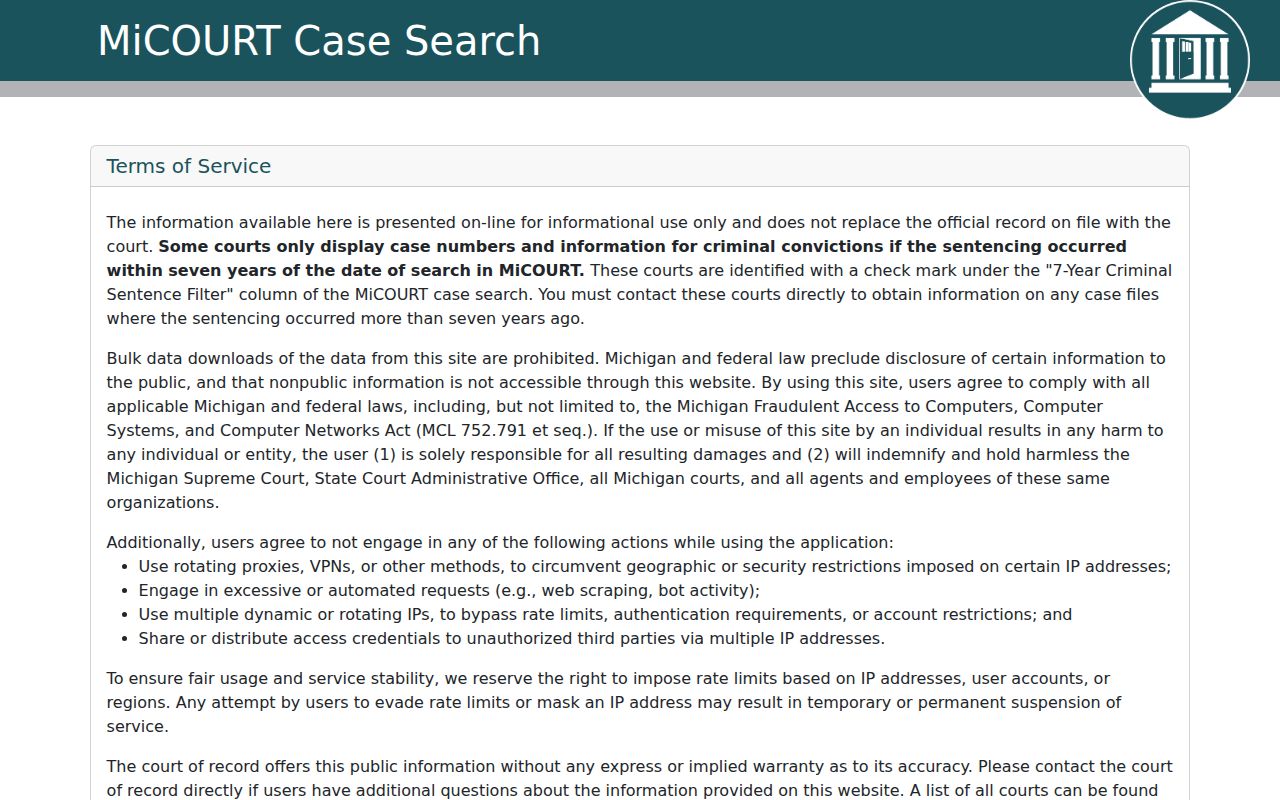
MiCOURT is a statewide search for participating Michigan trial-court history, not the official court record. The page asks users to accept terms before searching. Court selection matters: use the Michigan Trial Court Directory to identify the court, then search by participant name or case number. Name matching begins with the entered surname prefix, so try meaningful spelling variants; a case-number query can match a value within the number.
| Field | Type | Required | Options/format notes |
|---|---|---|---|
| Court/courts | Dropdown/multi-select | Yes for targeted search | Select one or more participating Michigan courts; use Trial Court Directory to resolve county. |
| Case number | Text | Optional | API says it contains the search value in the case number. |
| Last name | Text | Optional | Name search matches participant names beginning with entered value. |
| First name | Text | Optional | Combine with last name; variants matter. |
| Case type/category | Multi-select filter | Optional | Civil, traffic, criminal, domestic/divorce/family, probate, depending on court; API filter uses case-type codes. |
| Filing/date range | Filter/date pair | Optional | Use to narrow common names; exact web controls vary by court. |
| Court division/status | Filter | Optional | Court-specific refinement; the complete option list is not exposed in the protected page. |
| Search / Continue / Case Details | Buttons/links | As prompted | Results open a public history/detail view; the official record remains with the court. |
Some courts apply a seven-year criminal-sentence filter, so older criminal history may not appear; the court's marker identifies that filter. MiCOURT excludes many categories, including juvenile and child-protective matters, adoption, name changes, mental-illness cases, personal-protection orders, and sealed or other protected matters. Bulk downloads and excessive or automated requests are prohibited. Public history inspection is free, but copies can cost money. A certified copy generally costs $10 plus $1 per page under MCL 600.2546, subject to other controlling rules. Ask the clerk about archived files, transcripts, documents, or certification. Federal matters go through PACER and the federal district clerk.
Before viewing the consent notice and search controls, see the MiCOURT case-search page.
A docket sample may show these fields:
| Field | What the docket may show |
|---|---|
| Case number, court code, case type, filing date | The court identifier, kind of matter, and start date. |
| Participant/party name, party type/number, alternate names, attorney | Who is listed, their role or party number, name variants, and counsel. |
| Answer date, service date | Dates of listed response or service events. |
| Disposition, disposition date | The recorded outcome and date shown. |
| Party action category, action, action date, action due date | Event labels and any displayed action or due date. |
| Charge/offense fields, related case details | Criminal charge details when applicable and links to related case detail. |
Public web history does not guarantee document images. Sealed, juvenile, set-aside, and protected personal information may be absent or redacted; ask the clerk about a public terminal or file-copy process for eligible documents.
- Docket
- A dated log of case events and actions, not the full file itself.
- Index and image
- An index is a searchable set of reference fields. An image is a view of a scanned document, when one is available for public release.
- Certified copy
- A copy the issuing custodian certifies as a true copy; it is different from an index entry or an ordinary screen view.
Michigan Voter Lookup and QVF Resident-Search Limits
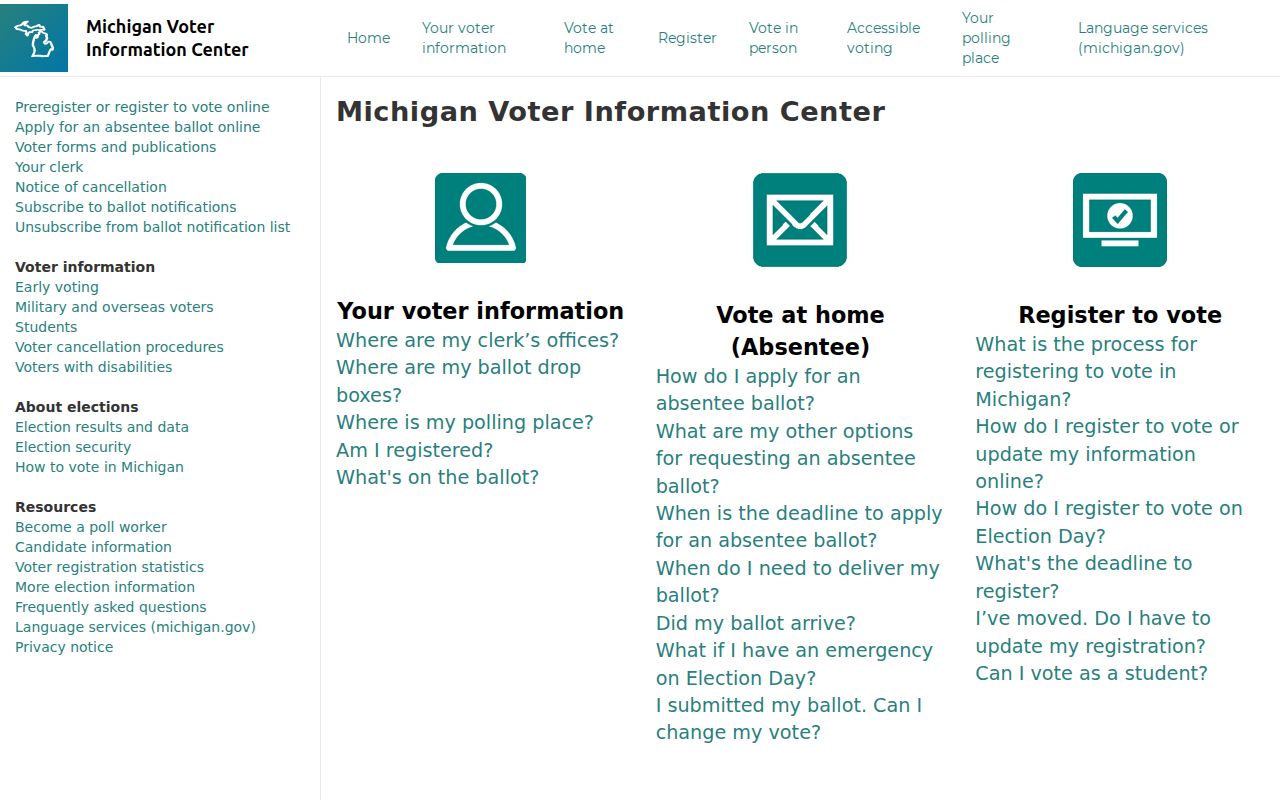
Michigan.gov/Vote provides an individual registration and status lookup, plus a way to find the local clerk. It is useful for checking a registered voter, not for listing every person in a household. If the public status page does not resolve the question, a QVF data request goes to the Bureau of Elections using its official request form.
The requester supplies name and contact details, chooses one geography, signs and dates the request, and selects delivery. Scope choices include the whole state, a county, city or township, district, school, village, ward, or precinct. Optional history choices can narrow the file to vote type and date. Delivery options are pickup, FTP, or mail. The response is a fixed-length ASCII file, so it is a data extract rather than an instant name-search page.
Depending on scope, the file may include full name, residential and mailing addresses, year of birth, registration date, status, voter ID, voter history, and jurisdiction codes. It withholds month and day of birth, driver or state-ID numbers, phone, email, digitized signature, SSN4, declination, and registration-agency identity. Michigan has no party registration, and a primary choice or history is not a party label. Local clerks are the fallback for a jurisdiction-specific question. Never try to reconstruct an Address Confidentiality Program participant's physical address from a substitute address.
For an example of the individual status screen, see the Michigan voter lookup.
Michigan Resident Lookup: Vital Indexes and Certified Copies
Michigan's statewide vital registration begins in 1867 for births, deaths, and marriages; divorce registration begins in 1897. Those dates describe records held, not a promise that every event is indexed online. The Michigan Department of Health and Human Services (MDHHS) and local registrars hold vital records, while libraries and historical indexes can help locate older entries before a copy request.
For deaths from 1867 through 1897, the state GENDIS index contains more than 460,000 entries. Michiganology has death certificates for 1897–1946, with indexing to 1952. Library marriage indexes cover 1867–1921 and 1950–1969; returns, registers, and Ancestry images extend through 1952. Library divorce indexes cover 1897–1969, with summaries for 1897–1922 and Ancestry images through 1952. These are leads to an event, not a certified record.
Eligibility depends on record type and age. A birth record at least 100 years old may be certified to any requester; genealogy transmission uses 110 years for birth and 75 years for death, marriage, and divorce under MCL 333.2885. Current birth copies are restricted to eligible requesters with identity and proof. Anyone may request a marriage search with a completed, signed, paid application, but a search, certified copy, and confidential probate marriage are different things. A death-copy order does not require photo ID under MDHHS instructions. Vital records are not FOIA records under MCL 333.2888.
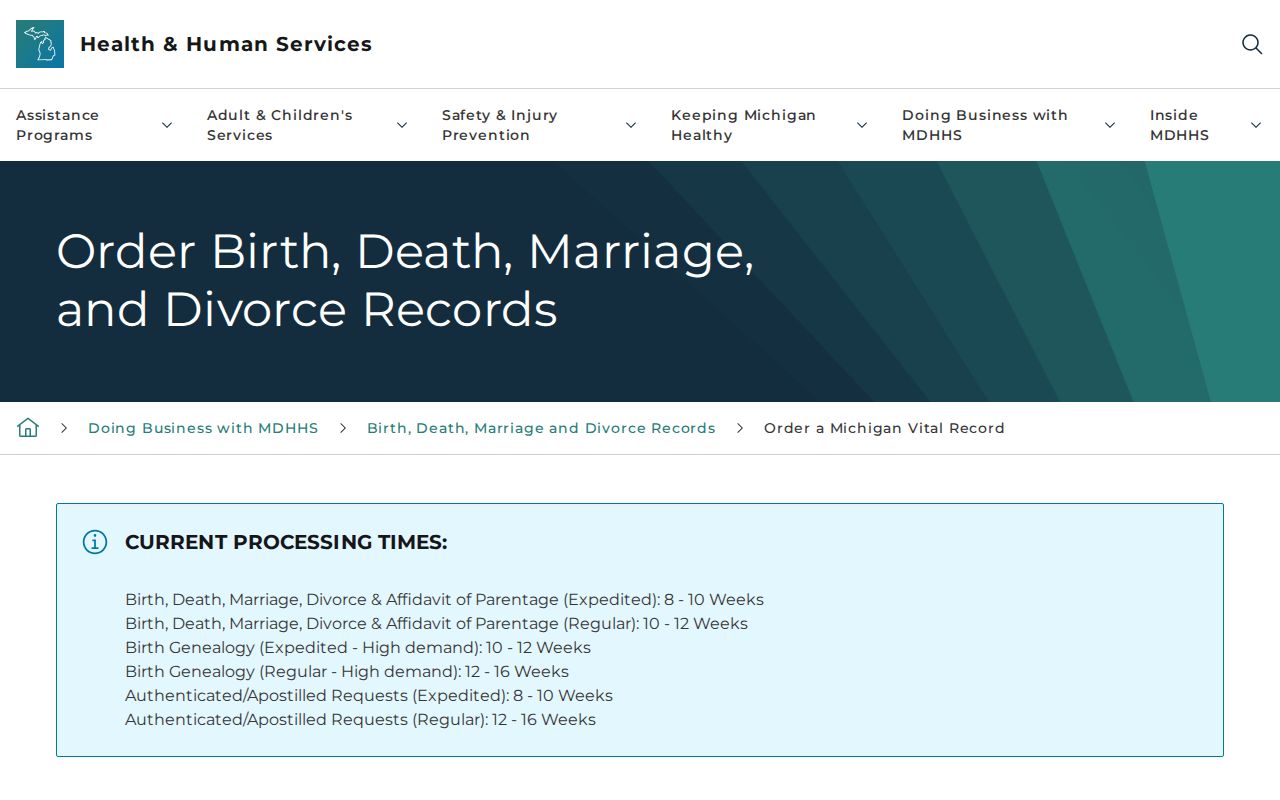
MDHHS lists a $34 search and copy fee, plus $14 online processing. Requests can go through VitalChek online or by phone at 866-443-9897, by mail, or through the Lansing lobby drop box on weekdays from 7 a.m. to 5:30 p.m. Appointments are available Tuesday and Thursday from 10 a.m. to 2 p.m. Online Will Call orders are processed in 2–5 business days after receipt and picked up Tuesday or Thursday. The office is at 333 S. Grand Ave., Lansing, MI 48933; customer service is 517-335-8666 or 517-335-8660. Regular processing is estimated at 10–12 weeks, expedited at 8–10 weeks; genealogy estimates are 12–16 weeks regular and 10–12 expedited.
Review the MDHHS order instructions before sending an application. A divorce certificate is not the complete court file: request a decree or case file from the court that granted the divorce.
Before paying for a copy, check whether an index, library register, or local record answers the family-history question. When a legal copy is needed, request it from the custodian and use the proper eligibility basis.
Michigan Custody and Registry Searches Answer Different Questions
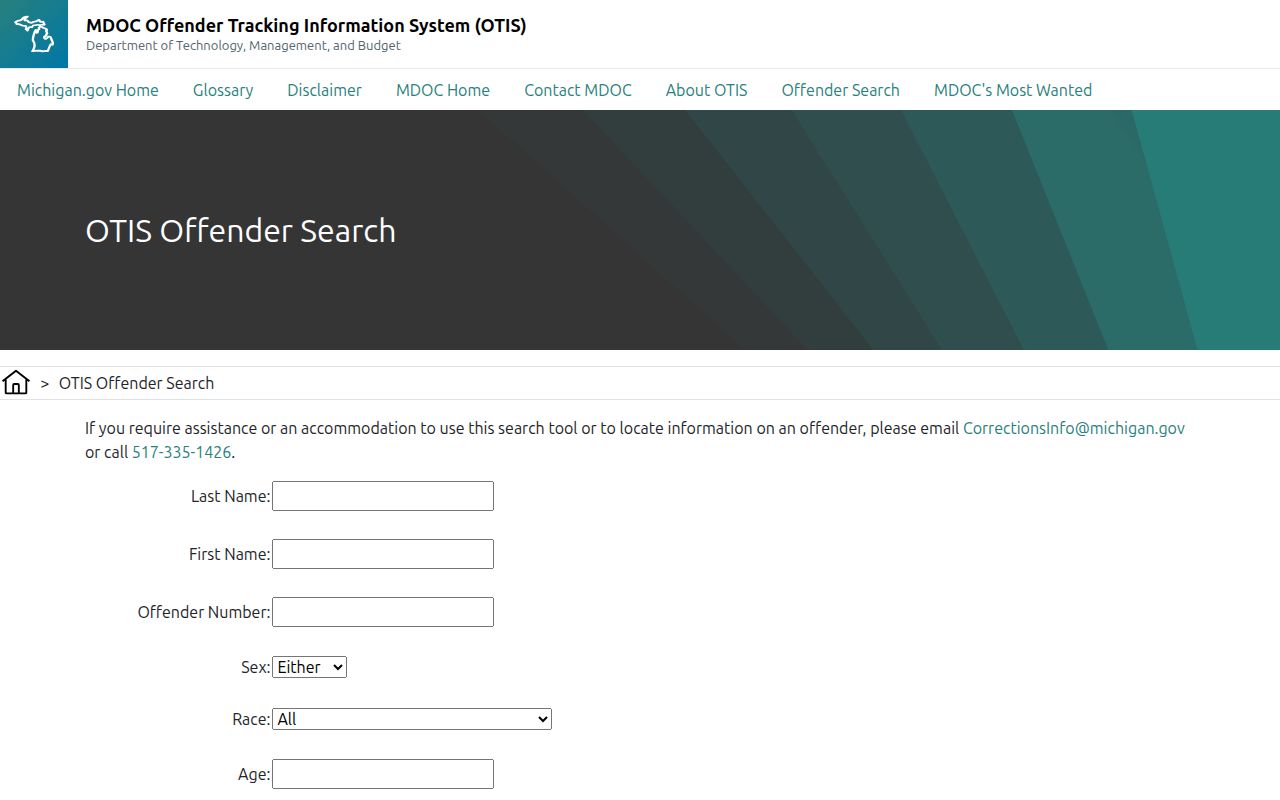
Three public systems can appear in a name search, but they do not describe the same kind of record. OTIS covers people in MDOC custody or parole/probation supervision, interstate-compact cases, and supervision discharged within three years. Its fields include name, offender number, sex, race, age, status, and marks, scars, or tattoos. It is not a county-jail roster or a full criminal history, and MDOC says a result may not reflect current location or status. Michigan has no single statewide jail roster; check the county sheriff for a current booking or older local record.
See the OTIS search page for the fields used to narrow a name search.
MSP ICHAT is the separate name-based public criminal-history search and costs $10 per search. Its $30 fingerprint route returns a complete personal record, including public and nonpublic information, to the authorized subject. A court file remains the source for a case disposition. The Michigan Public Sex Offender Registry (PSOR) serves a separate safety purpose and offers search by name, registration number, address, city, county, ZIP, or neighborhood radius of .25, .5, 1, 2, or 5 miles. Victim information is withheld, juvenile adjudications are not shown, and the site does not offer a whole-list download.
Its official registry search shows the available ways to define an area.
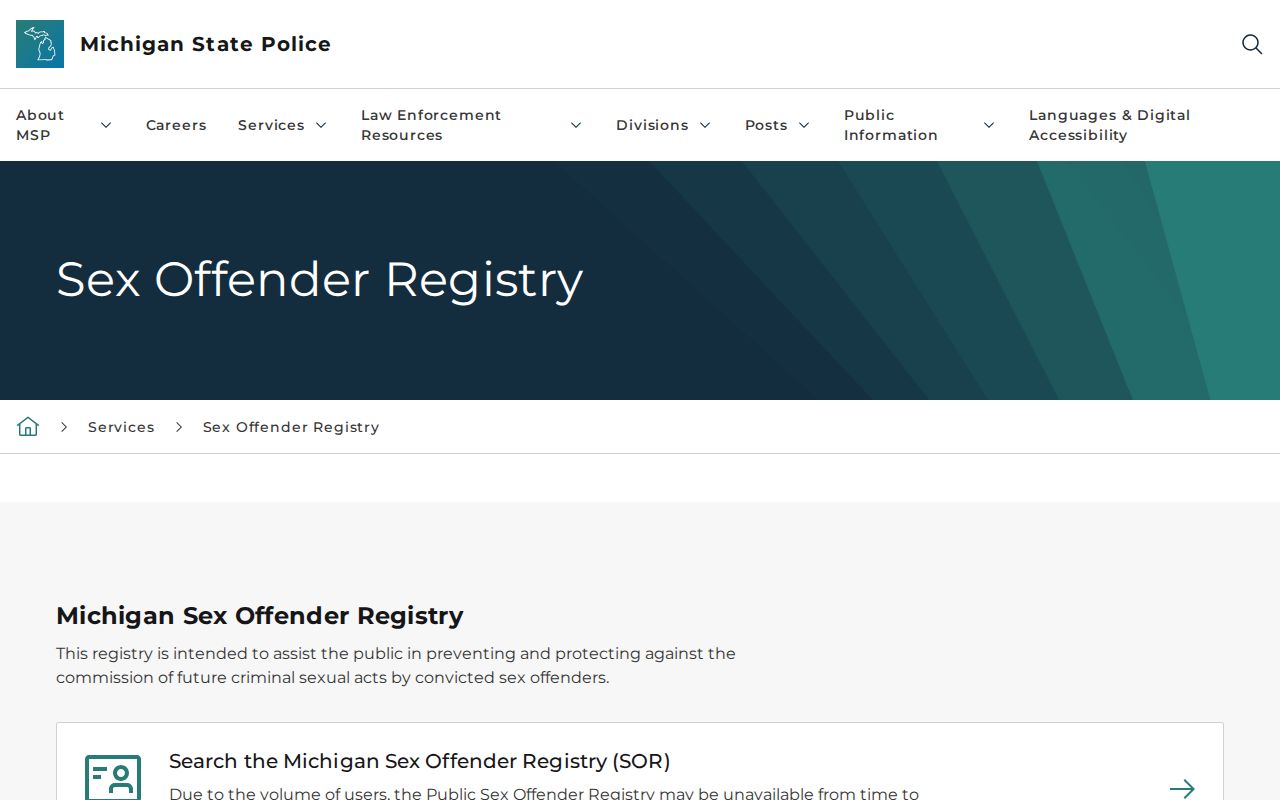
Compare a name, aliases, date details, and official case information before drawing a conclusion. An OTIS no-hit may reflect a county jail, an older discharge, spelling differences, or a record outside OTIS's scope. No single one of these systems proves identity or supplies an all-record history.
Michigan Resident Search for Heirs, Classmates, and Business Links
A one-person search works best when it follows the reason for looking. Probate is the official route for an heir: start with the estate docket, then request eligible filings such as a will, inventory, or final account from the county probate court. An obituary and a deed can help test a family relationship, but neither replaces the court file. For a birth-parent inquiry, use Michigan's confidential adoption-record or identifying-information process, including an authorized intermediary where applicable, rather than trying to infer a private address from unrelated records.
Former classmates are more likely to appear in library yearbooks, newspaper alumni notes, reunion material, or university alumni channels. A historical directory or obituary may give a dated town or household connection; it cannot establish a current address. Michigan Treasury's unclaimed-property search may surface a former-address clue, but a claim requires proof and is not evidence of where someone lives now.
For a business affiliation, use the LARA business and professional lookup page, then check county assumed-name filings where relevant. The LARA entity search supports name modes such as begins-with, exact, keyword, and Soundex, as well as entity and filing numbers. Filed records can list an agent, officer, member, or manager; licensed-professional portals vary by field. An agent or registered office is an official business contact, not proof of a private residence. MiBusiness Registry replaced legacy corporate-system URLs in June 2025, and individual-name history depends on the system.
See LARA's category page for the available business and license routes.
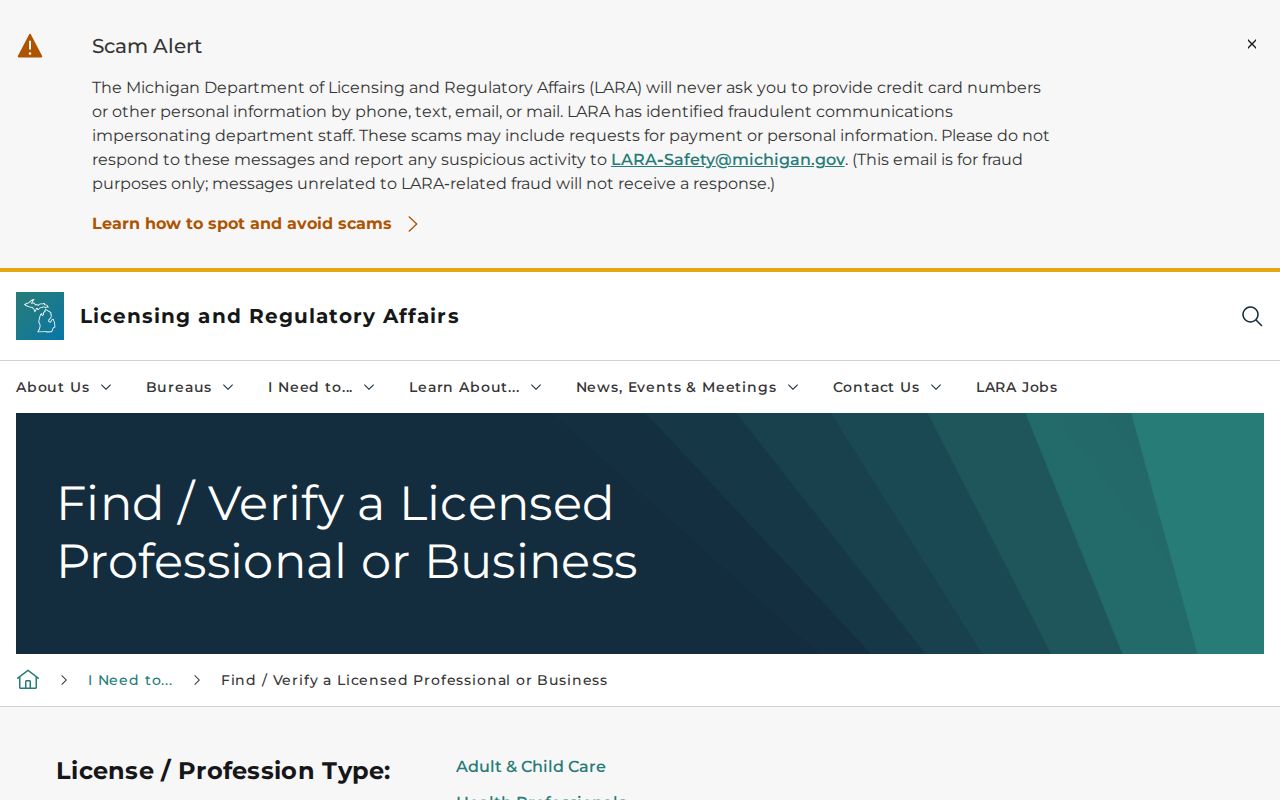
For a local trade name, pair a state entity filing with the county clerk's assumed-name record. Save the filing number, status, date, and named role so the affiliation stays distinct from a home or household link.
The Michigan Resident-Search Myth: One Index Covers Everyone
Michigan has no single public deed index for all counties and no statewide county-jail roster. A person may also appear in none of the owner, voter, or court-party records, especially if the record concerns another household member or the source is private. That is why a statewide portal can be a starting point without being a complete answer. For address-based work, the Michigan street-address directory follows county property sources; older household volumes belong with the Michigan city-directory collections.
When an online search ends, contact the office that keeps the record. Send a clear written request with the person's name, county or court, approximate date, address or case number, and record type. Ask for inspection or a copy, and request a fee estimate before ordering a large file. A local assessor can look for an offline parcel card; the Register of Deeds can explain a deed index or image gap; a court clerk can locate an archived file; and a county sheriff can answer an older booking request.
Michigan FOIA is a route for records held by covered public bodies, not a way around every record-specific law. Vital records are excluded, and court history and copies follow court access rules. Libraries and Archives can fill historical gaps, while an agency-specific mail, phone, counter, appointment, or clerk process may be needed for current records.
Commercial people-search services may join old addresses, property, court and business fragments. Results can be stale, combine people with similar names, or show a mailing contact rather than a residence. Their opt-out steps differ, and a listing may return. Use an official record to verify a claim; a private profile is only an unconfirmed lead.
Michigan Privacy Rules and the Limits of a Resident Search
Public information and private household data are different. Michigan's rules depend on the record: voter fields have statutory redactions, vital records are restricted under MCL 333.2888, and driver's-record data is protected by the federal Driver's Privacy Protection Act and MCL 257.208c. Juvenile, sealed, set-aside, adoption, and protected court matters do not belong in ordinary public results. Never publish full birth dates, signatures, phone numbers, private email, or protected addresses simply because another field is public.
The Address Confidentiality Program, created by Act 301 of 2020, serves people affected by domestic violence, sexual assault, stalking, human trafficking, or risk of harm. A qualifying participant can receive a designated address, a corrected state ID, and free mail forwarding after contacting a victim advocate or application assistant. Forwarding may add three to five days. People subject to sex-offender registration or who have already given the confidential address to the Secretary of State may be ineligible. Some government agencies may obtain the physical address for a legitimate government purpose; private entities are encouraged, but not universally required, to accept the substitute address. Stop at the designated address and do not use another source to reconstruct the physical one.
Michigan does not provide one statewide broker opt-out that deletes public records or ends every private listing. A broker may ask for matching identity or address details and a confirmation, and a profile can reappear. That request does not remove the original deed, voter, court, or vital record. Keep the search narrow, describe each field accurately, and ask the record's custodian about a correction or redaction route.
Lawful personal use. A Michigan resident lookup is for lawful, personal research. Public records do not permit following, threatening, or harassing someone; Michigan's stalking law, MCL 750.411h, covers repeated conduct that causes fear or intimidation.
Correct a Michigan Resident Record at Its Source
Send an error to the office that created the field. Ask the assessor about a parcel card, MDOS or the local clerk about voter data, the court clerk about a case index, MDHHS about vital-record corrections, MDOC or the court about an OTIS entry, and LARA about a license or entity filing. Include the record number, the exact field, and the supporting proof the office requests. Keep the written response with the source citation so the correction trail stays clear.
A directory, commercial profile, or search result cannot change a public record. If the source is correct but an old copy elsewhere is not, use the publisher's own correction or opt-out process and keep the underlying government record separate from that private listing.