
Michigan’s Historic City Directory Shelves
Michigan has no single complete run of city directories. The Library of Michigan guide lists Polk and R.L. Polk alongside Robinson’s, Norton’s, Johnson Publishing, W.C. Bailey, and Luedder. Holdings are local and irregular, so the table separates the best-described city runs from statewide reference shelves. A year range means the catalog or collection description reports those volumes; it does not promise that every edition is online.
| Collection | Years | Where Held | Access |
|---|---|---|---|
| Detroit directories | 1837; 1845–46; 1850–1941; selected East/West volumes through 1974 | Burton Historical Collection; Google Books for some volumes | Onsite reference collections; selected digitized pages |
| Flint directories | 1885; scattered 1868–1954 | Burton Historical Collection; local repositories; University of Michigan/Google Books | Onsite collections and selected scans |
| Grand Rapids directories | Scattered 1868–1954; complete 1888–1922 in Burton’s description | Burton Historical Collection and local repositories | Check the item or catalog record |
| Battle Creek Polk | 1880–1995, in an irregular sequence | Western Michigan University Archives and Regional History Collections | Consult the collection by volume and year |
| Ann Arbor, Ypsilanti, and Washtenaw examples | 1890, 1910, 1913, 1916, 1920, 1921 | University of Michigan/Google Books, Library of Michigan, local libraries | Selected digitized books and local holdings |
| Flint digitized Polk | 1918, 1920–1922 | University of Michigan/Google Books | Full-view digitized items |
| Statewide directory publishers | Many holdings reach the late 1800s; varies by locality | Library of Michigan, 2nd Floor South, print, rare books, microfilm, and fiche | Catalog, onsite material, Ancestry Library Edition, and HeritageQuest |
| Gazetteers and business directories | Intermittent 1856/57–1931/32 | Library of Michigan, 2nd Floor North; call number HC107.M5.S752z | ANSWER catalog, microfilm, or rare-room material |
| Telephone books | Detroit most complete from 1878; other towns roughly 1939–1980s | Burton Historical Collection and local libraries | Onsite local-history or microfilm holdings |
| State telephone/government directory | 1935–2005, various years | Library of Michigan government documents | Consult the catalog or government-documents collection |
The table records surviving or described holdings, not a promise of annual publication. Detroit’s regular run is strongest from 1850 to 1941, followed by selected split editions rather than an unbroken sequence. Other cities have scattered years, and one institution’s catalog may list only the books it holds. Before planning a visit, search the catalog by city, publisher, year, and alternate place names, then ask the holding library whether the volume is on site, on microfilm, or available through a reading room.
Michigan City Directory Formats: Polk and Bresser
Polk and Bresser books answer different questions. A Polk name section is usually the easiest route when a surname is known: it can give a person’s occupation, other household members, address, and ownership status. Separate street sections list residents or businesses in house-number order, while phone sections name the head of household. If the name spelling is uncertain, check likely variants and then use the street pages to see whether the address matches.
Bresser’s criss-cross format reverses the path. It lists streets alphabetically and occupants or businesses by house number, with phone number and owner/renter notation where recorded. Some volumes also note the year first listed, arrivals, or relocations. That makes Bresser useful when the address is known but the householder’s name is not. An insider’s shortcut is to pick the format based on the known detail: search Polk by name, or open Bresser at the street. Then compare the result with an adjacent year, because an index entry alone may omit the move that explains a changed name or number.
Detroit’s East and West Directory Years
Detroit’s cataloged sequence starts with an 1837 volume, includes 1845–1846, and becomes regular from 1850 through 1941. The later run is selective and divided by side of the city, so a single year may have an East edition, a West edition, or only one of them. The surviving list names 1953 West, 1954 East, 1956 West, 1957 East, and 1958 West; later entries include 1963 East, 1964 East and West, 1965 West, 1967 East, 1968 East and West, 1970 East and West, 1973 West, and 1974 East.
Check the cover and area heading before deciding that a person vanished. If a family lived near the dividing line, inspect both editions when both exist. Burton holds the historical collection, while some older Detroit books have digital copies. The dates describe known volumes, not a claim that Detroit stopped printing in all other years. For an address that changes over time, write down the edition’s side, year, page, and printed street spelling alongside the person’s name.
- 1837: earliest Detroit directory identified in the collection guide.
- 1850–1941: the regular Detroit sequence described by the Library of Michigan.
- Late 1960s onward: Bresser criss-cross volumes generally begin, with city-specific coverage to verify.
- 1974 East: last Detroit edition in the listed selected East/West run.
Michigan Regional Directory Runs
Flint’s holdings show why a statewide search needs city-level checks. The Library of Michigan guide identifies an 1885 directory and scattered books from 1868 through 1954; Burton has some volumes, and University of Michigan/Google Books has selected digitized editions. Full-view Flint Polk volumes are listed for 1918 and 1920–1922. Those few online years can help identify a household, but they do not bridge every gap in the local run.
Grand Rapids has scattered coverage from 1868 to 1954, with Burton’s description calling 1888–1922 complete. Battle Creek has a much longer Polk sequence, but it is irregular: 1880, 1896, 1913, 1918, 1924, 1926, 1929, 1937, 1939, 1945–46, 1949, 1951–52, 1954–63, 1965–66, 1968, 1971–73, 1977–80, 1983, 1985, and 1993–95. Western Michigan University’s Archives and Regional History Collections holds that series. Ann Arbor, Ypsilanti, and Washtenaw examples appear in 1890, 1910, 1913, 1916, 1920, and 1921; check a county volume’s coverage heading because one book may include more than one municipality.
Michigan’s 1900 Detroit Directory Scan
The Detroit City Directory for 1900 is an R.L. Polk volume, number 38, digitized by Google Books from Harvard. Its record shows the title, publisher, year, original library, digitization details, and selected pages. Visible index terms include personal names, Detroit streets, occupations, household and widow marks, businesses, and page references. A lead-in search by surname can supply a page to inspect, but optical text can mix an entry with a nearby street or column.
The public Google Books view may show snippets or selected pages rather than a complete book download. Treat the scan as one access route, then check the catalog or a library copy if a needed page is not visible. Keep the printed page number and image or scan reference with each note, since a search result and a full page view are not the same thing.
The Google Books record for the digitized 1900 Detroit directory identifies the scanned Polk volume and its page access.
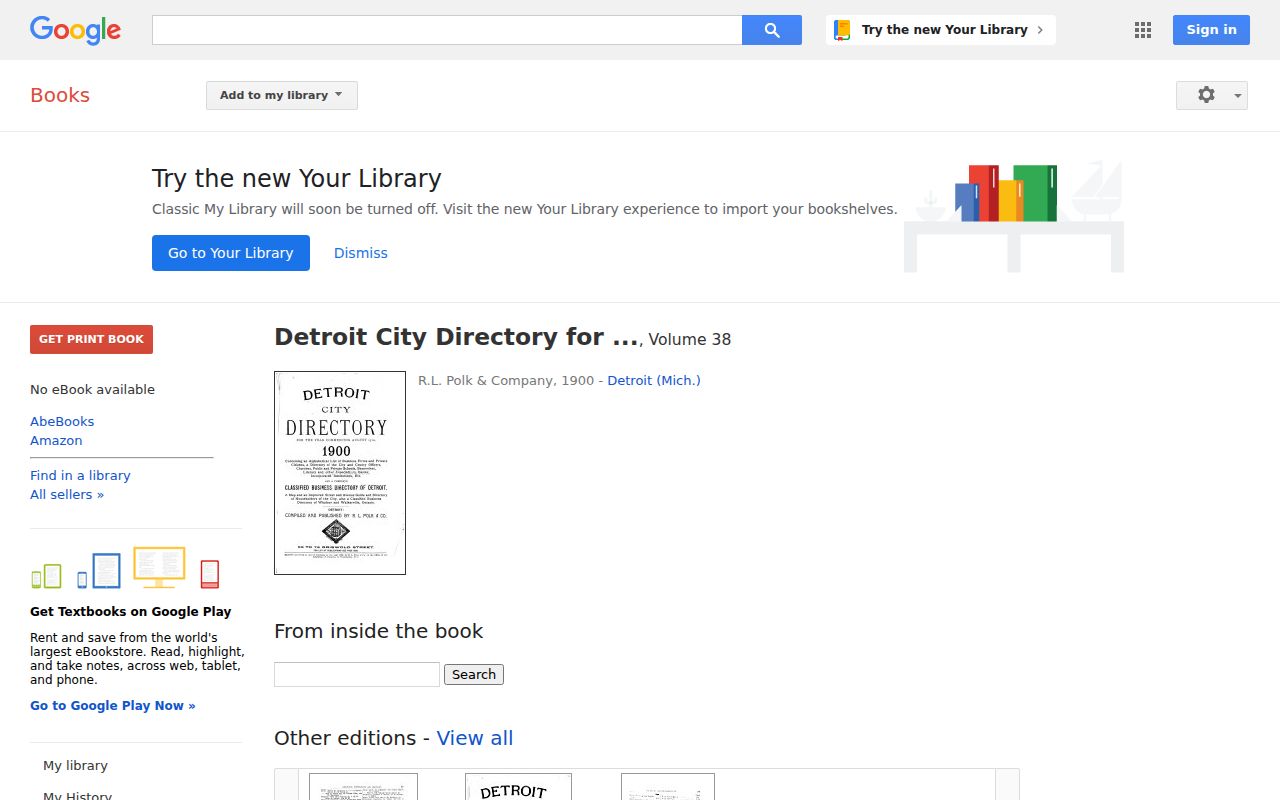
The catalog image helps locate the correct year and volume; check the page view itself before relying on a transcribed name or address.
Reading Michigan Directory Entries
A printed entry is a compact set of clues, not a full household record. In the name-first part of a Polk book, begin with the surname and note the spelling as printed. The next lines may show an occupation, other household members, address, or ownership status. Use the book’s own abbreviation key rather than guessing from a familiar-looking mark. Street and phone sections can add another route to the same person, but phone sections generally identify the head of household.
| Entry part | What to record |
|---|---|
| Name and household | Exact printed spelling; spouse or other family members where shown. |
| Occupation | The listed occupation, which can help distinguish people with the same name. |
| Address | House number and street, including direction or suffix if printed. |
| Owner/renter mark | Copy the symbol or wording used in that edition; not every book uses the same key. |
| Widow notation | For example, “wid” followed by a spouse’s name, when the entry includes it. |
Common Polk abbreviations include h for home, bds for boards, rms for rooms, and wid for widow of. Other occupational shorthand can include bkpr, carp, condr, mach, phys, tchr, and tmstr. A scan’s text layer can merge a name with the adjacent column, so compare it with the page image and the volume key.
- Criss-cross directory
- A street-first listing, usually with occupants or businesses arranged by house number.
- Householder index
- The name-first section used to find a listed person before checking a street section.
- Abbreviation key
- The book’s explanation of short forms and marks; consult it before interpreting an entry.
Michigan Telephone Directories and Gazetteers
Telephone books can bridge a phone number to a name or address, but their coverage and purpose differ from household listings. Burton’s Detroit holdings are most complete from 1878; telephone directories for other towns are generally described from about 1939 into the 1980s. Local libraries may hold additional paper or microfilm issues. Michigan’s state telephone and government directories cover various years from 1935 to 2005 and focus on state agencies, staff, and office contacts rather than a full city household list.
Gazetteers fill a different gap. The Library of Michigan lists intermittent state business and gazetteer volumes from 1856/57 through 1931/32, held on the second floor north in print, microfilm, or rare material under HC107.M5.S752z. They can identify businesses, professions, advertisements, and community context. They are not a substitute for a household directory. Search the ANSWER catalog by title, author, subject, or keyword, and ask staff whether a specific volume can be viewed in the reading room.
Burton Historical Collection Access
The Burton Historical Collection at the Detroit Public Library is a key onsite stop for Detroit and Michigan local history. It is at 5201 Woodward Avenue, Detroit, MI 48202; the research contact is (313) 481-1401 or bhc@detroitpubliclibrary.org. The collection lists books, manuscripts, maps, newspapers, photographs, family histories, church and military records, obituaries, land records, and city directories. No-appointment hours are generally Tuesday through Saturday, 2–6 p.m., and Sunday 1–5 p.m. from October through May; appointment schedules vary, so confirm access with the collection before traveling.
The Burton Historical Collection’s research page gives current contact and access details for the Detroit reading room.
Burton staff can direct a researcher to directory volumes and related newspapers, maps, obituaries, yearbooks, and cemetery or church sources held in the collection.
Michigan City Directory Resources
The Library of Michigan’s local-history shelves include paper and microform histories for counties, cities, villages, townships, and neighborhoods. Its city-directory and gazetteer guide explains publisher formats and holding locations, with catalog searches available through ANSWER.
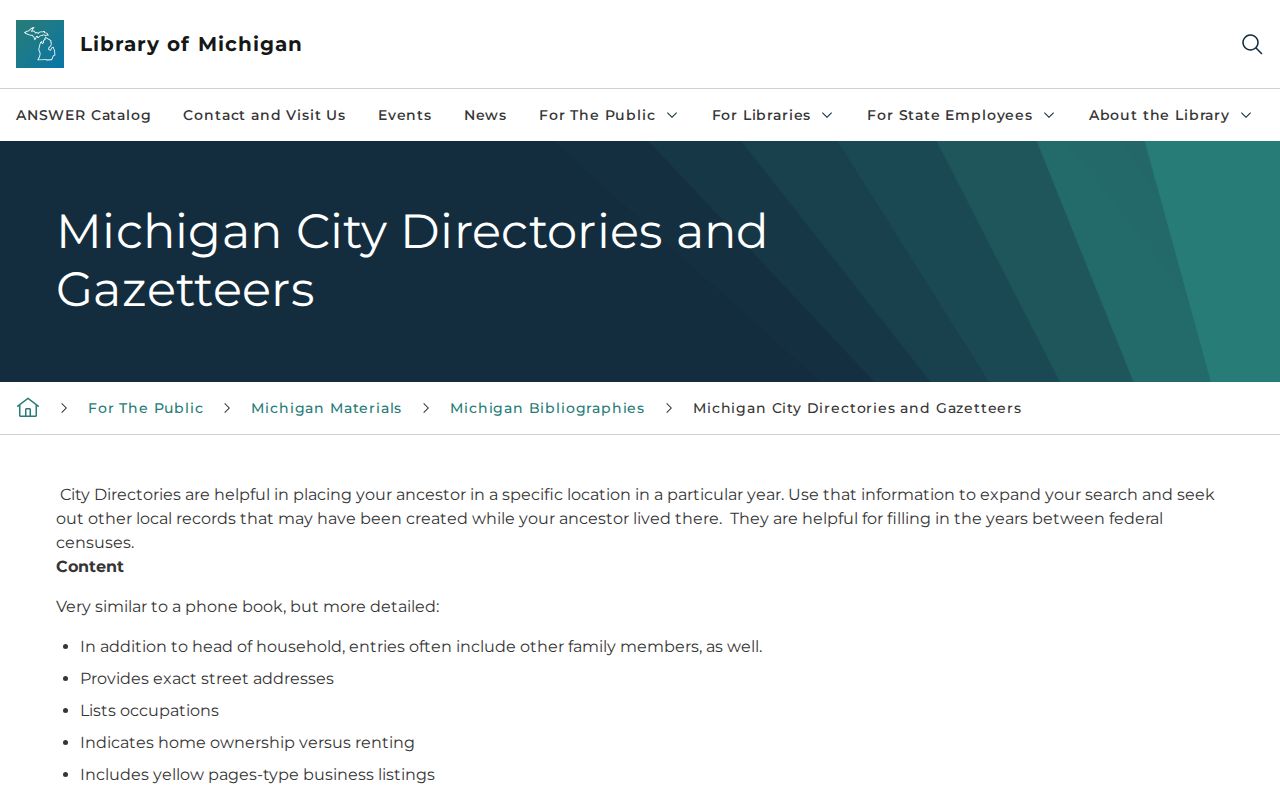
The guide is a routing tool, not a statewide promise of complete year-by-year coverage, so check the local catalog record for the volume needed. The Library of Michigan’s cardholder-resources page also lists digital history tools for remote or onsite research.

For online research, the Library of Michigan points readers to Ancestry Library Edition, HeritageQuest, FamilySearch, and other genealogy resources. Ancestry Library Edition is available onsite at Burton; MyHeritage is offered through the Michigan eLibrary. Access can depend on the service and collection, so confirm whether a record image is open remotely or only at a library.
Missing Michigan Directory Years Are Not Proof
A missing volume does not show that a home was empty or that a family left town. The collection may have a local gap, a split East/West issue may cover only one side, or a copy may exist at a repository that is not represented in the catalog first checked. Polk and Bresser runs vary by city, and even a long sequence can skip years.
Use the nearest available year as a dated observation, then test it against another source. A federal census can describe a household at its enumeration date; a newspaper notice, obituary, church record, or cemetery entry can help explain a later change. Michigan directories were produced and preserved locally, so there is no single statewide list that proves every city and year is represented.
Michigan Archives and County Guides
When the directory shelf runs out, the Archives of Michigan and local repositories can point to records that place a family in a county or community. State archives holdings reach back to 1792, but not every record is digitized. County guides identify public record groups and partner repositories; use the county and the date of the event to account for older custody boundaries. The Library of Michigan’s ANSWER catalog also searches local histories in paper and microform.
The Archives of Michigan county-guides page is the statewide entry point for county-level holdings and repository notes.
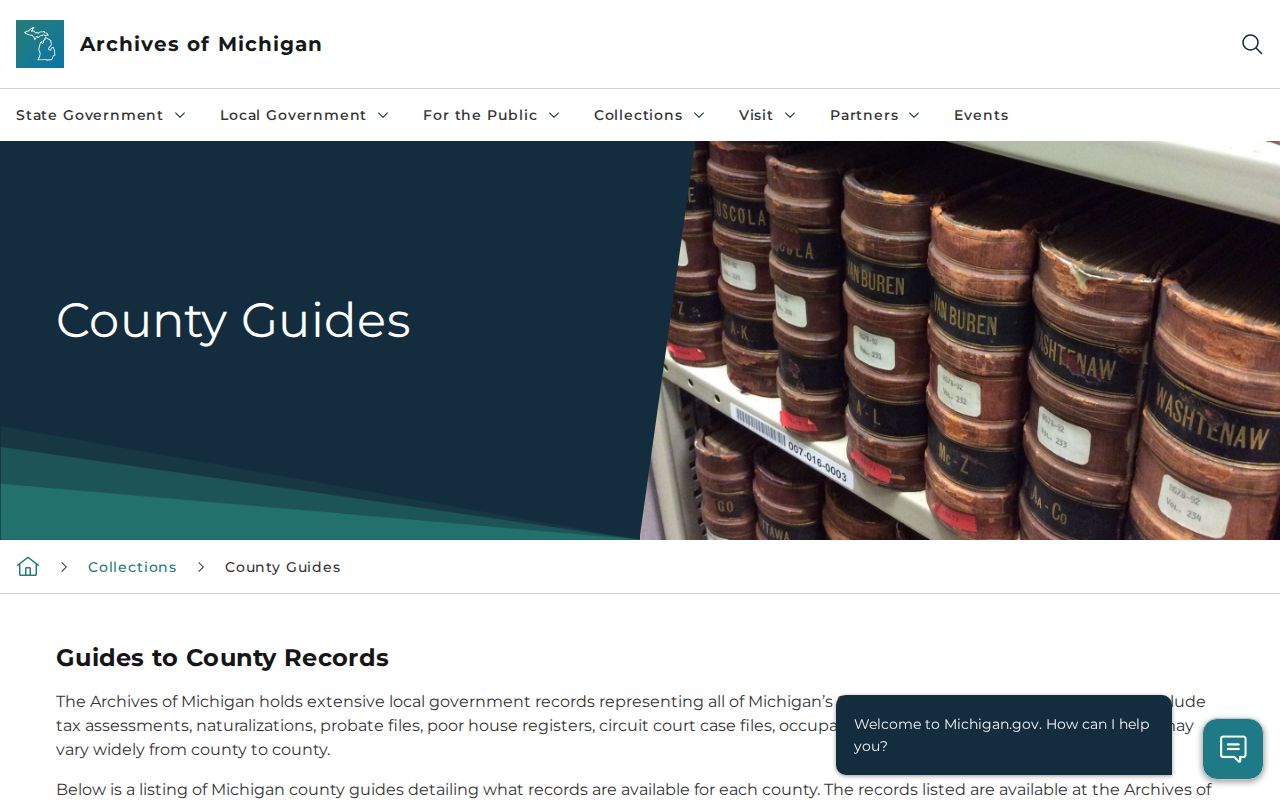
County guides help route a search when printed volumes, microfilm, and local history books sit in different collections or have not been digitized.
The Library of Michigan’s online-resources page lists Sanborn maps from 1867 to 1970 where coverage exists. The maps show buildings and street context rather than household names, so they can help place a directory address without serving as a resident list. The resource page also describes onsite and cardholder access for its digital collections.
Michiganology’s searchable collection page includes death records, maps, and main-street material. University of Michigan and Google Books hold selected digitized directories; the Western Michigan University Battle Creek Polk collection record adds another city-specific run. Wayne State’s Walter P. Reuther Library and other university special collections hold related local material, including newspapers, yearbooks, and city histories. Check each catalog item for actual dates and image access rather than assuming that a university-wide collection covers every year.
Trace Michigan Families Through Directory Years
For family history, set down the exact city, street spelling, printed year, volume, page, and edition side each time an entry appears. Then follow the name forward and backward through the volumes that survive. Pair the address with the closest federal census, which is publicly released through 1950 under the 72-year rule. Census schedules and directories were made at different times and ask different questions, so compare the household members and address without assuming that every detail will match.
- Find the person in the name section and copy the exact spelling, address, year, page, and volume.
- Check the next available directory year for a new address, a changed household listing, or a first-listed note.
- Use a street-first Bresser volume, where available, to check the occupants recorded at the address.
- Compare the closest census household and enumeration district, noting that its date and questions differ from the directory.
- Use local newspaper, obituary, church, cemetery, probate, or vital indexes to test a move, marriage, or death when the evidence supports it.
Michigan’s genealogy collections can extend the trail. The Library of Michigan points to FamilySearch and Ancestry for selected vital records and census material; Michiganology has death-certificate images for 1897–1946 and indexing through 1952, while the GENDIS death index covers 1867–1897. Older certificates and images can have access limits, so check each collection’s date range and viewing rules. An obituary or cemetery entry can suggest a family link, but it is a separate source to compare, not a substitute for the original directory page.
When a name disappears, possible explanations include a move, death, a change in how the household was listed, or a missing edition. Check the next available book and the address section before drawing a conclusion. For current address records, use the Michigan street-directory address workflow rather than treating an old directory as proof of present residence.