
Searching the Michigan Residents Directory
A search is easier when it begins with the question the record can answer. A Michigan assessor can show who owns a parcel, but that name may be a company, an agent, or someone whose mailing address is elsewhere. Michigan.gov/Vote checks an individual’s registration status. A deed index shows parties to a transaction, while a court index records a case role. None alone proves that a person lives at a home today.
Choose a county before searching. Michigan has 83 counties, and each has its own Register of Deeds, clerk, courts, and local assessment systems. Write down the person’s full name, any known municipality, a likely date range, and the record number or parcel ID as each source provides it. A cross-record search becomes more reliable when two records share a place and date, not just a common name.
- Resolve the county and municipality from the address, then open that assessor’s property search.
- Compare the owner name and parcel ID with the person’s known details; keep mailing and site addresses separate.
- Use the state voter lookup for an individual status check, or review the QVF request rules for geographic files.
- Check a court or vital-record index only when its record type fits the question and its access rules permit it.
- For a past household, turn to a library directory or archive; for a record that is offline, ask the correct custodian.
The trail can stop when a person is a renter or household member rather than an owner, voter, or party to a public case. Michigan does not publish a master household list, so a missing match is not proof that someone moved or never lived there.
Who Keeps Michigan Resident Records
Michigan records sit with several custodians. The state keeps vital records, election systems, corrections data, and historical government files. County and municipal offices keep much of the property, deed, court, permit, and local-history material. A search that crosses county lines needs a fresh check of the local portal and its coverage notes each time.
Archives of Michigan
702 W. Kalamazoo St.
Lansing, MI
Reading room: Monday-Friday, 1-5; Saturday, 10-4
MDHHS Vital Records
333 S. Grand Ave.
Lansing, MI 48933
517-335-8666 / 517-335-8660
Vital-record orders and requests
Michigan Bureau of Elections
PO Box 20126
Lansing, MI 48901-0726
Statewide requests: Elections@Michigan.gov
Michigan.gov/Vote
Resolve the County Before a Michigan Resident Search
Michigan’s 83-county structure is the first practical search fact. An event, parcel, or court case belongs to the county and municipality that held the record at the time. The county Register of Deeds list helps identify the right land office, but it is not a statewide deed search. A voter question may lead to a county, city, township, or village clerk instead.
County names can also change the archive path. Wayne County was Michigan’s first county in 1796, when its borders covered land that later became parts of several neighboring states. The current 83-county map took shape over time, so an early deed, naturalization, or court file may be cataloged under a predecessor county. Use the event date and the old boundary, then ask the current county office or the Archives of Michigan where that series went. The state list of Registers of Deeds helps locate the county custodian.
Michigan Residents Start With Assessor Records
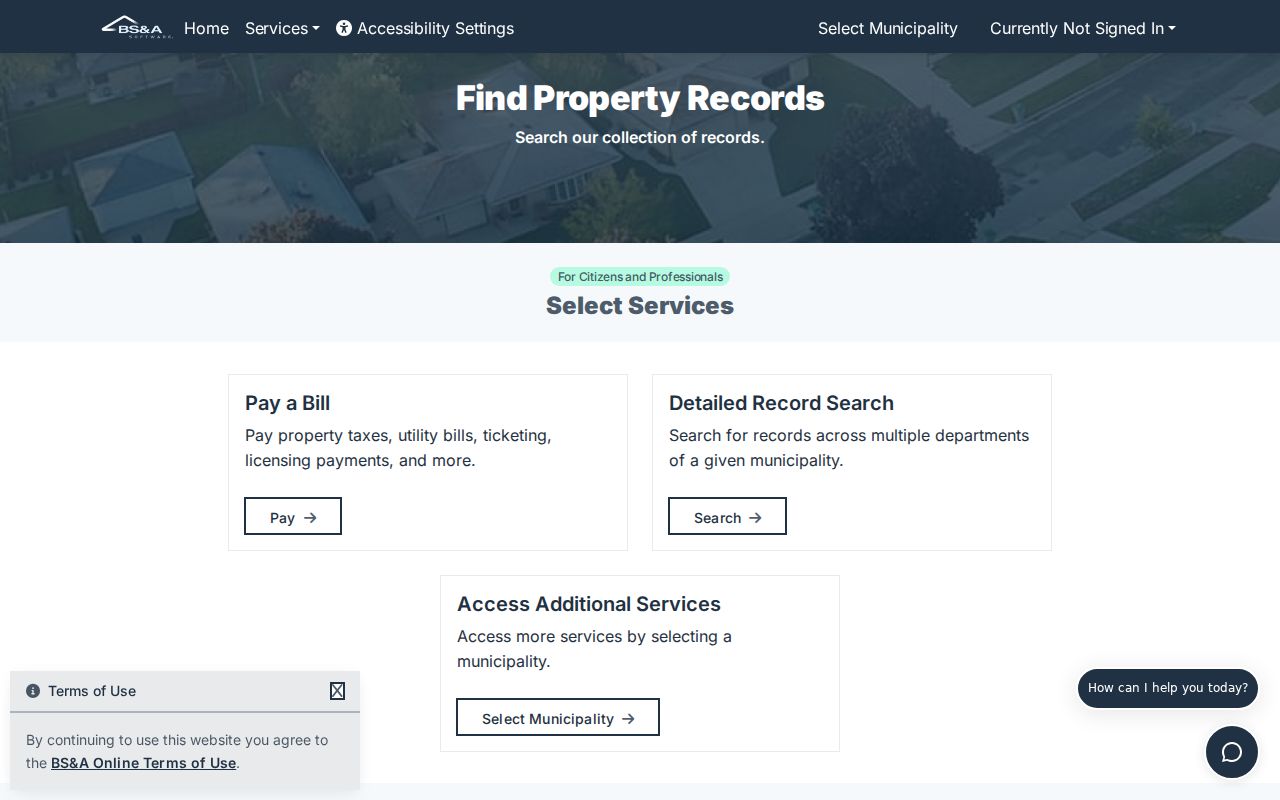
Most Michigan property searches start by choosing a city, township, or county. BS&A Online is a common municipal gateway, but it does not combine every assessor into one uniform owner search. The selected government unit controls which names, parcels, tax details, and documents are visible. A street search may be available after the municipality is set, while a rural parcel may be easier to find by owner or local parcel ID.
The BS&A gateway’s municipality picker shows why the first choice matters. The screen below is an entry point to local records, not a statewide list of Michigan households. Once a municipality is known, save the exact parcel code and move to the county map or Register of Deeds only when the source provides that next key.
For a street-by-street walkthrough, the Michigan street directory page follows the parcel, deed, voter, and older address records in more depth.
Current Michigan Resident Records by Custodian
Today’s public systems are separate indexes with separate rules. The records trail may identify an owner, a registered voter, a party named in a deed, or a professional with a license. It does not combine those people into one list, and each result should be described by its source rather than treated as proof of current residence. Taken together, these resources form a route among custodians, not a statewide roster.
| Source | Who It Lists | Keeper | Access |
|---|---|---|---|
| Assessor / tax roll | Owner of record, parcel, mailing address, assessment fields | Local assessor or municipality | Local portal or office; fields vary |
| Voter lookup / QVF | Registration status and limited voter data | Michigan Bureau of Elections and local clerks | Individual lookup or scoped data request |
| Deed index | Grantors, grantees, instruments, legal descriptions | County Register of Deeds | County-specific index, images, mail, or counter |
| Court history | Public case parties, dates, and dispositions | Participating court and court clerk | MiCOURT plus clerk access; exclusions apply |
| Historical directory | Dated household, street, occupation, and phone clues | Libraries, archives, and local collections | Print, microfilm, catalog, or database access |
| Professional or business file | License, entity, agent, or filed business role | Michigan LARA and county clerks | Official search; association is not residence |
For a current property question, start with the local parcel roll; for a registration question, use the voter system; for ownership history, follow the county deed index. A name search needs a second anchor, such as a county, date, record number, or known address. An owner entry is not the same as a resident entry, and a court party may share a name with someone else.
Michigan Residents and Public Voter-File Limits
Michigan.gov/Vote lets a voter check individual registration status and find the local clerk. A public status lookup answers a narrow question. It is different from the Qualified Voter File request form, which asks the requester to choose one geography, such as a county, city or township, district, ward, or precinct, and a delivery method.
The QVF file can include a voter’s name, residential or mailing address when available, birth year, registration date, status, voter ID, and selected history. It does not release the full date of birth, driver or state-ID number, phone, email, signature, SSN4, or the fact that someone declined to register. Michigan does not register voters by party, and the roll does not disclose ballot choices. Use the local clerk if the public lookup cannot resolve the right jurisdiction.
The official QVF data request form requires requester details, one selected scope, a signature, and pickup, FTP, or mail delivery. It is a formal file request, not an instant public people search.
Cross-Checking Michigan Residents in Court Records
MiCOURT Case Search can show a public case history from participating Michigan trial courts. A name match needs a second anchor: county, case number, party role, filing date, or another fact visible in the public record. The portal is informational, and the court clerk remains the custodian of the file and certified copies.
Search by a participant’s surname and first-name prefix, or use a case number when one is known. Court selection and case-type filters vary. Some courts apply a seven-year criminal-sentence filter, and the portal excludes sensitive groups of cases such as adoption, juvenile, child-protection, name-change, and certain protective-order matters. A blank result may reflect those rules or a county whose records are not shown online.
Public case history and a court document are not the same thing. Ask the clerk how to inspect an older file, order a copy, or obtain certification. Court copy fees follow court rules, not Michigan FOIA, because the judiciary is outside the FOIA definition.
Michigan Residents and Vital-Record Event Rules
Michigan vital records can confirm a life event and sometimes a family link, but the certificate is not open to every requester. State registration began in 1867 for births, deaths, and marriages; divorce records begin in 1897. The law draws a line between an index, a genealogy copy, and a certified record that can serve as legal evidence.
For family history, the state’s genealogy window generally opens after 75 years for death, marriage, and divorce records, and after 110 years for birth records. A birth record 100 years old may be certified to any requester under a separate rule. Current birth copies have eligibility limits. Marriage search requests can be made by anyone who submits a signed and paid application, though a search is not the same as a certified copy and confidential probate marriages have tighter access.
The MDHHS order page linked in the records-office card lists online, phone, mail, drop-box, appointment, and Will Call routes. Vital records are outside FOIA under the Public Health Code. When a certificate is restricted, use a library index, obituary, church book, or cemetery record as a lead, not as a substitute for the official record.
Michigan Parcel Records Start With a Map
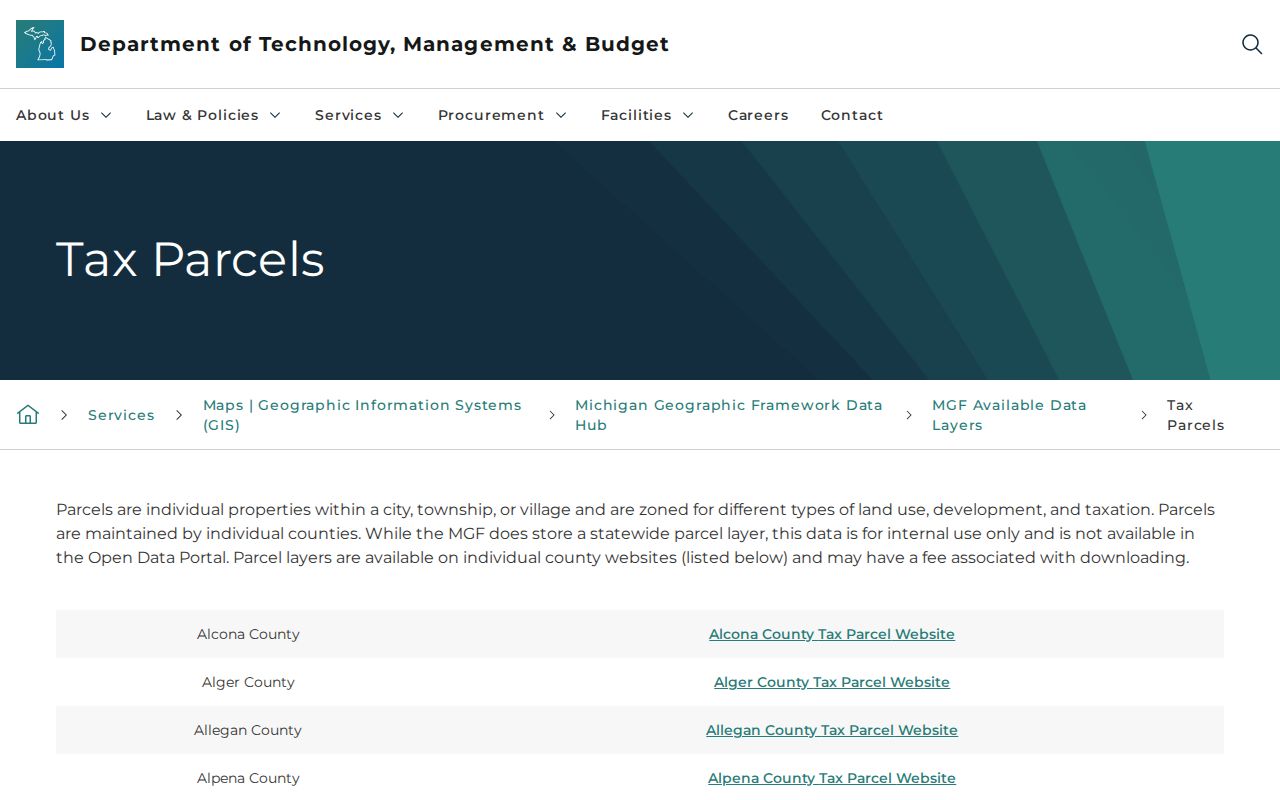
The statewide parcel page points to county-maintained parcel layers and explains a key limit: Michigan does not offer one public, owner-linked parcel viewer for the whole state. County GIS and municipal assessors supply the local detail. The state’s map services add boundary and road context, but they cannot replace the parcel card or county deed index.
The Michigan DTMB tax-parcel page shows the county-based structure behind the search. Use the state source to identify a county link, then confirm the parcel code and legal description with the local assessor.
A map can locate a property or show which parcel touches it, but it does not identify every person in a home. The county’s own record controls the owner field and the information that can be shared.
County Deed Records Carry Michigan Ownership
Each county Register of Deeds holds recorded land instruments. Michigan has no single statewide public deed index. A county portal may search a grantor, grantee, parcel, legal description, book and page, or document number, but the field set and online cutoff vary. Use the Michigan Register of Deeds list to identify the custodian for the county where the land sits.
Ingham County illustrates why a search needs a date check. Its free Direct Search provides an index, with newer days withheld from that view; Tapestry and Laredo provide image access under different payment arrangements. The index begins in 1956, images in 1960, and the office warns that 1956-1981 entries can have conversion errors. Records are also searchable in the courthouse vault by appointment, and earlier copies may be held at the Mason office. This insider detail matters whenever a digital result looks incomplete.
A deed names parties to a transfer, not all occupants. A grantee receives an interest; a grantor conveys one. The deed’s legal description, instrument number, and date are stronger cross-checks than a matching name alone.
Michigan Business Records Show Public Roles
Michigan’s LARA portals can confirm a licensed profession, facility, or filed business association. A business record may list an agent, member, officer, manager, or registered office. Those are formal roles or contact points, not proof that a person lives at that address. Local assumed-name filings may sit with a county clerk, so a statewide business search is not the end of every local query.
The MiBusiness Registry replaced legacy corporate-system URLs on June 23, 2025. Use the current Michigan Business Entity Search for entity or associated-person searches, then open the filed document when the role matters. The LARA license lookup routes searches across health, trade, commercial, care, cannabis, fire-safety, and liquor categories. Local permit, cemetery, animal, and niche license systems remain uneven.
Michigan Resident Search Fields Need a Local Match
These tools do not share one statewide form. The first choice often sets which record system or county is searched. Optional details narrow a result, but they do not make one portal’s coverage complete. State systems also answer different questions: MDOC’s OTIS covers people in prison, on parole or probation, and some discharged from supervision within three years; it does not cover county jail bookings. Michigan has no statewide jail roster. A local sheriff’s page or records unit is the route for a county booking. The state sex-offender registry has its own legal limits and cannot be treated as a full court history.
| Portal | Field or Choice | Type | What It Narrows |
|---|---|---|---|
| BS&A / assessor | Municipality; owner; street address; parcel ID | Dropdown and text | One local assessment roll |
| Michigan.gov/Vote | Name, address or registration detail; clerk jurisdiction | Lookup fields | Individual voter status |
| QVF request form | County, jurisdiction, district, ward or precinct | Single scope choice | One lawful data geography |
| MiCOURT | Court, participant name, case number, type and date | Selection and text | Public case history |
| OTIS | Last and first name, offender number, sex, race, age, status, marks/scars/tattoos | Text and filters | State supervision, not county jail |
| PSOR | Name or number; city, county, ZIP, address and radius | Text and filters | Registry result; no full-list download |
| LARA facility search | Facility, licensee, address, city, ZIP, county, status | Text and dropdown | License or facility record |
Field labels and exact options can change by county or state portal. Keep the original query and the result’s case, parcel, or license number with the search date. A no-hit in OTIS may mean a county jail, a discharge outside its time range, or a name variation. ICHAT is a separate name-based state criminal-history search. Check the court that handled a case before drawing a conclusion from any one result.
- Roll
- A continuing list maintained by an office, such as a property assessment or voter registration roll.
- Index
- A searchable reference to a record; an index entry may not include the full deed, case file, or certificate image.
- Situs address
- The location of a parcel, which can differ from the owner's mailing address and does not identify every household member.
| Search Type | What the Official Record Can Support | What It Cannot Establish Alone |
|---|---|---|
| Government index or record | A dated filing, registration, parcel, license, or case role from the named custodian | Current residence, a family relationship, or an identity match without corroboration |
| Commercial people-finder category | A lead compiled from purchased and public data, which may help locate an original record | Complete coverage, current occupancy, or a reliable match across people with similar names |
Public records are best checked at their source. A commercial result can combine old addresses and business or court fragments, but it may be stale, merged, or tied to a mailing address rather than a home.
Michigan Resident Address Records Have Privacy Limits
Open records do not include every address or household member. Michigan voter records withhold sensitive fields under Election Law. Vital records are controlled by the Public Health Code. Driver and vehicle data are protected by the federal Driver’s Privacy Protection Act and Michigan law. Utility customer lists and private association rosters are not general public resident rolls.
The Michigan Address Confidentiality Program gives qualifying people a designated address and mail forwarding after they apply through a victim advocate. It does not authorize a searcher to reconstruct the person’s home from other files. If a public result shows a substitute address, stop there and preserve the person’s privacy.
Use public records lawfully. A record may support personal, family-history, property, or civic research, but it is not permission to stalk, harass, threaten, or expose someone. Use the custodian’s correction route when an official entry is wrong.
Request Michigan Records Through FOIA
When an online search ends, first confirm which office keeps the record. A city clerk may hold a permit, a county Register of Deeds may hold a deed image, and a court clerk may control the case file. The Michigan Attorney General’s FOIA guide explains how to send a written request to the public body’s FOIA coordinator.
Describe the record clearly enough to find it: name or parcel number, county or municipality, type of record, likely date range, and preferred inspection or copy. A public body usually has five business days to respond and may send one written extension for up to ten more business days. Fees can cover permitted search, review, separation, copies, and postage. Courts and vital records follow other access rules.
For older material, ask whether the office transferred it to the Archives of Michigan or a local partner. The county guides identify holdings across the state, but not every series has a web index or online image.
Michigan Deed Records and Scam Mail
A letter offering a deed copy for a high fee can look like an official bill. The Michigan Attorney General’s records-scam alert warns residents to compare such offers with the county Register of Deeds and obtain the record directly from its custodian. A deed-copy solicitation is not a required county charge just because it uses public parcel information.
Some counties offer a property-fraud alert service that sends notice when a document is recorded. Wayne County announced a free alert example in 2025, but other counties may use a different service or none at all. Confirm any signup from the official county website, and independently find the office’s published contact before paying or sharing personal details. Government pages end in the official Michigan domain; a caller or mailer should not be trusted from its logo alone.
Michigan’s consumer-protection office also advises people to report impersonation and identity-theft concerns through its official channels. Keep the envelope and document number if the letter names a real parcel, then ask the Register of Deeds whether it refers to an actual filing.
Michigan Residents Directory: Historical Sources
Michigan’s historical directories survive in uneven local runs. The Library of Michigan city-directory guide describes Polk and other city directories in print, rare books, microfilm, and selected online collections; local libraries and the Burton Historical Collection add city-specific volumes. Some runs reach the late 1800s, while gaps between years are common. A missing book cannot prove that a home was empty.
Polk often begins with a surname and can include occupation, household members, and a street section. Later Bresser criss-cross books begin with the street and list occupants in house-number order. Pair a directory entry with a census, newspaper, vital index, or deed record from the same period. The Michigan city directory collections page covers the local year runs and ways to reach them.